
Wheel Terminology
Backspace
The dimension measured from the far back edge of the rim shell to the back- side of the center disc. (hub mounting surface)
To Measure: Use a straight edge across the backside of the wheel and measure to the backside of the center.
Bolt Pattern
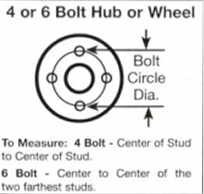
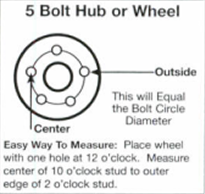
The diameter that the studs pass through.
CAUTION: The hub mounting surface of the wheel must be fully supported by the hub. Check hub diameter to be certain it exceeds the wheel torque ring diameter. An undersized hub diameter will cause wheel failure.
WHEEL TERMINOLOGY
BEADLOCK: A mechanical means of attaching the tire to the wheel so that the tire does not unseat or spin on the rim shell (normally used in dirt track racing when running extremely low air pressures) and (in drag racing to keep the tire from spinning on the rim shell). A Beadlock wheel has an inner ring with threaded holes welded to the outer edge of the wheel. An outer ring is used to clamp the tire to the inner ring thus locking the tire to the wheel.
BOLT CIRCLE: See the box on right side of page 29 for bolt circle explanation and how to measure.
OFFSET: This term is often confused and misused. Offset is the dimen- sion from the centerline of the rim shell to the back side of the center. This is a hard dimension to measure and for this reason and simplification we use the term BACKSPACE. See the box on right side of page 29 for backspace explanation and how to measure.
ROLLED SHELL: This is the standard method of making a rim shell. Mild steel is used and rolled into a tube shape, and then the seam is welded. The tube then goes through a series of rollers that form the con- tour of the rim shell. The shell’s bead seats are then expanded to its final size. A rolled rim shell is fine for Saturday night race applications.
SAFETY BEADS: Safety beads are the “bumps” or protrusions on the rim shell, just inside where the tire beads sits. DOT street legal wheels require safety beads to keep the tire seated on the rim shell in the event of a flat tire. Safety beads are what causes the “pop” sound when a tire is aired up. Safety beads are used in racing applications when running low air pressures on dirt and in drag racing to keep the tire from spinning on the rim shell. Safety beads can be rolled into any of our rim shells when requested.
SPUNSHELL: In spin forming a rim shell, high-strength low alloy steel is used, which is stronger. The material is rolled into a tube shape and then the seam is welded. The tube is then placed over a die. The spinning machine then forms the rim shell to the exact shape of the die. It does not need to be expanded to final size, as all shells spun are shaped to the die. In the spinning process, material thickness can be manipulated to be thicker where extra strength is needed. A spun rim shell makes a stronger, more precise wheel, for the higher speed and more demanding racing applications.
TORQUE RING: The torque ring of a wheel is the protruded area sur- rounding the bolt circle on the back side of the center disc. The torque ring provides the contact area with the hub. The back side of a wheel center disc is not flat, but has some critical forming which shapes the torque ring. The torque ring keeps the area around the stud holes away from the hub surface. As the lug nuts are tightened, the center has a small gap which pulls in creating a lock washer effect. A proper torque ring is what keeps the lug nuts from loosening up.
Caution: Not all hubs and wheels are not created equal. Be sure to check that your hub O.D. is big enough to support the torque ring of your wheel
Weight listed are approximate for rim size. Weights may vary due to different centers, suppliers and material thickness variations from batch to batch of supply.
Warranty Disclaimer: Due to unpredictable racing conditions, there is no warranty written, expressed or implied. User assumes all liabilities, responsibilities and risks in using these products.